
If you live in the UK and need hearing aids, there’s a good chance you’ll be offered them through the NHS. Many people assume the NHS only provides outdated hearing aids that don’t work very well, but that’s not really true. In fact, the technology you may receive might surprise you.
How to get NHS hearing aids
If you choose to go private and pay for hearing aids yourself, the process is usually much faster. After an assessment you could be fitted with hearing aids within a few weeks.
Getting hearing aids through the NHS usually takes longer. The first step is to visit your GP and ask for a referral to the ENT (Ear, Nose and Throat) department at your local hospital.
Waiting times can vary depending on the hospital, but it’s not unusual to wait up to six months before your first appointment. That might sound like a long time, but considering the hearing aids and ongoing care are free, many people find it worth the wait.
What happens at the hospital?
When your appointment arrives, you’ll see an audiologist. They will ask a few questions about your hearing and any problems you’ve been experiencing. They will also look inside your ears to check for things like wax or other issues.
After that, you’ll have a hearing test to find out whether you have hearing loss and how severe it is.
What is a hearing test?
A hearing test is simple and completely painless.
You’ll sit in a very quiet room while the audiologist places headphones over your ears. Through the headphones you’ll hear a range of sounds at different pitches and volumes. Each time you hear a sound, you press a button to let the audiologist know.
The sounds usually start louder and gradually become quieter until they are too faint to hear.
You may also have a bone conduction test. For this test, a small vibrating device is placed on the bone just behind your ear. It sends sound through the bone directly to your inner ear. Just like before, you press the button whenever you hear a sound.
As the test progresses, the audiologist records your responses on a chart called an audiogram. The audiogram shows the quietest sounds you can hear at different pitches. This helps the audiologist understand the type and level of hearing loss you have, and which sounds you hear better or worse.
Here’s what an audiogram looks like.
The red lines and X’s show the right ear and the blue lines with O’s show the left. The lower the marks are down the chart the harder they are for you to hear.
On the left side of the audiogram you have 250Hz which are very low sounds such as the deep bass in music. On the right side you have 8000Hz which are very high pitch sounds which are sounds like birds singing.
This chart shows normal hearing at 250Hz, a slight drop at 1000Hz. After that the hearing drops down to the severe range. This person would need a hearing aid in both ears.

What hearing aid will I be given?
If the hearing test shows you have mild or greater hearing loss you will be offered an NHS hearing aid for each ear that needs it. The type you get depends on the level of hearing loss you have.
The general rule is the bigger the hearing loss the bigger the hearing aid will be. This is not the case if you buy hearing aids privately. However, the NHS does supply hearing aids that are smaller than they used to be and they are getting smaller and smaller as the years go by.

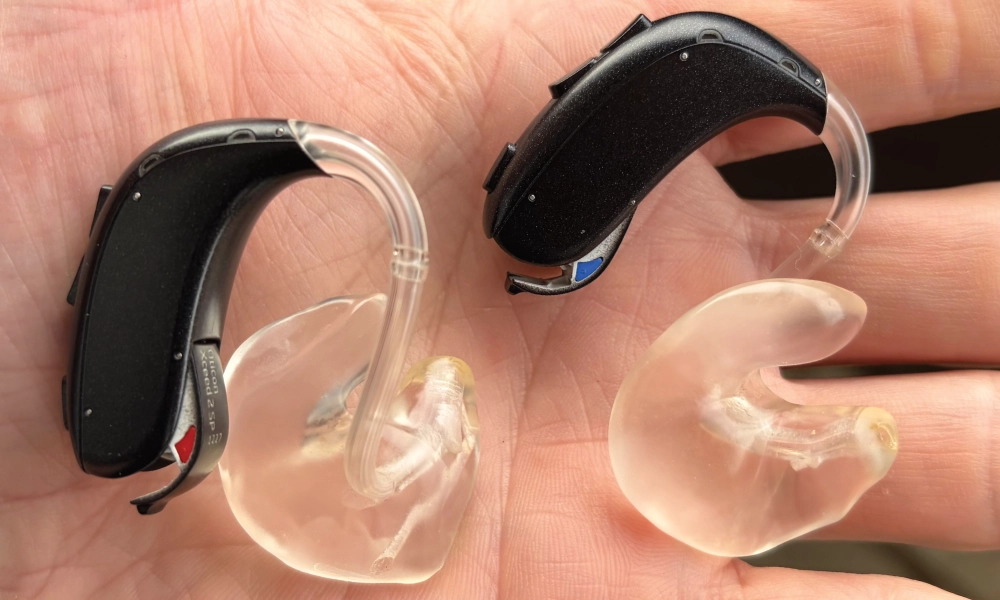
The hearing aids above are my Oticon Xceed 2’s they are for severe to profound hearing loss. They are Made For iPhone aids. These are currently one of the biggest aids that the NHS supplies. I wear them often and never really notice I have them on.
Most people will be given BTE “Behind The Ear” hearing aids. Again the size will depend of the hearing loss as the bigger the aid the more power they can produce and this greatly increases your chances of hearing much better.
It’s a bit of a postcode lottery when it comes to the aids you get on the NHS. It really does depend on the local funding rules but all NHS trust hospitals give out excellent quality hearing aids the are from Phonak, ReSound and Oticon.
Many people say that NHS hearing aids are cheaper old tech which is true to a point but most are now digital offering better sound, are bluetooth so they can be connected to mobile phones, TV’s and computers. Hearing aids that you can buy privately tend to be smaller and have better speech perception in noisy environments that’s the only real difference.
How long will you have to wait for your new aids?
Once your hearing test is completed and it’s agreed you need hearing aids you might be put back on the waiting list once again. In my case I had to wait another 2 months. Bear in mind that I already have NHS hearing aids and was upgrading to better suited hearing aids for my hearing loss.
What about the ear moulds?
The ear moulds that help funnel the sounds to your ear drums are made from either hard acrylic or a firm silicone. The NHS no longer offers a choice of colours so you’ll be stuck with a clear transparent mould that will in the end go yellow which is a little annoying.
When you’re approved for NHS hearing aids the audiologist with take impressions of your ears so that to moulds fit perfectly. They do this by filling your ear canal up with a liquid putty that sets to the shape of your ears. It’s not the most pleasurable experience but it doesn’t hurt at all.
What happens once I get my hearing aids?
On the day you get your new NHS hearing aids the audiologist will attach your new moulds to your new hearing aids, place them in your ears.
They will then connect them wirelessly to a computer where a program will work out what the level of hearing adjustments should be.
The audiologist will also do real ears measurements. A very thin probe microphone tube is gently placed into your ear canal. It sits a few millimetres away from the eardrum. Then your hearing aid is placed in your ear as normal.
The audiologist plays test sounds through a speaker in front of you. While those sounds play, the tiny microphone measures exactly how loud each frequency is inside your ear canal with the hearing aid running. Doing real ear measurements is a way of making sure you get the best sounds from your new hearing aids.
Once the above is done you will then have a chance to listen to what your new hearing aids sound like. You may be amazed or you may not. The important things here is to understand that your hearing in a completely different way to what you’re use to. Your voice might sound very loud and robotic, you may hear yourself breathing or sounds from outside of the room you are in.
The most important things is to understand that hearing new hearing aids messes with your hearing perception. It’s not a bad thing it means you’re hearing better but your have to give yourself a few weeks to allow your mind and brain to adjust.
What if I can’t get on with my hearing aids?
It takes time to adjust but if you are having a lot of problems with not being able to understand people speaking or certain sound are uncomfortably loud then your audiologist will adjust your aid on your follow up visit. It’s normal to have a few adjustments within the first few months.
What if I lose of damage my hearing aids?
If the worst happens then you can be grateful that you have NHS hearing aids that’s not to say it will not cost you as the NHS will charge you for the damage. At my local hospital to charge is £75 per aid for a total loss. Do you best to keep them in good condition and don’t lose them.
If you lose or damage hearing aids that you purchased privately you will have to pay the fall price and that could prove very expensive.